
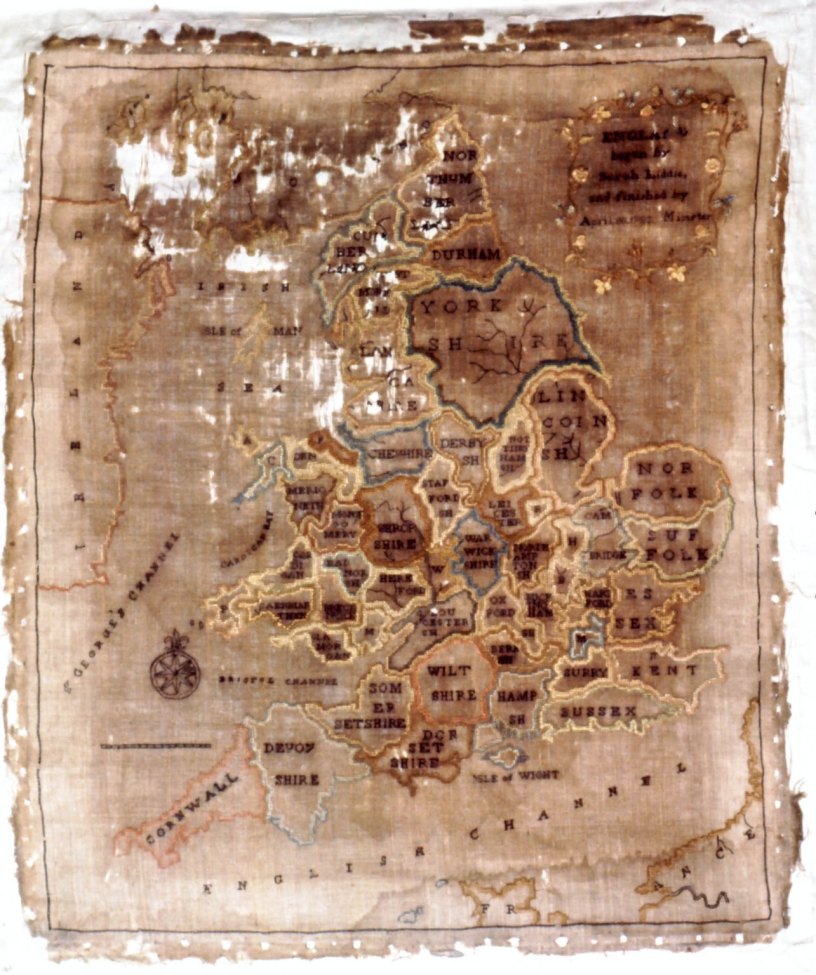
In the England of pre-history, so in the bronze and iron ages, settlements and hill forts emerged in a lightly populated landscape of farmsteads in a largely forested land. The country was divided into tribal areas with some fifteen emerging in the century before the Roman invasion as the most powerful, each under the rule of a king. The most significant, Catuvellauni under king Cunobelinus (brought to life for us by Shakespeare in his play Cymbeline) was north of the Thames with its capital at Verulamium (St Albans).
We have to thank the Romans for the names. In relation to the history there is the account of Julius Caesar who invaded in 57 BC and the earlier account of a Greek trader, Pytheas, who visited in 325 BC.
Back to kingdoms, there were then the Dumnonii in the south west, the Cantii of Kent and the Brigantes in the northern part of the country, and other smaller tribes. In very general terms those living in the west are thought to have come from the western coast of Spain and France and those in the east from north west Europe. Homo sapiens as a whole originated in Africa.
The southern part of the country was a place of arable farming and cattle with small enclosed fields. The north and west was more likely pasture for sheep, which had come to the island in around 3,000 BC with people migrating from the near east. Clothing was made of wool, and wheat was the staple diet. There is evidence of tin and copper mining in Cornwall, and mining elsewhere for iron and lead. Tin had been mined in Cornwall since 1,300 BC. There were probably ancient settlements in Leicester, Lincoln, Cambridge, Colchester, Rochester and Canterbury. Thatcham near Reading in Berkshire also has evidence of early settlement.
Places were linked. The Icknield Way ran from Buckinghamshire to Norfolk with lanes linking farmsteads. The Pilgrim way linked Canterbury and Winchester. Ermine Street became the Great North Road. The Fosse Way linked Lincoln with Oxfordshire, and Watling Street, Canterbury with St Albans running through London which then was probably no larger. When the Romans came at first they simply improved the existing routes.
The Romans invaded twice: in 57 BC and 43 AD but there is evidence of earlier and contemporaneous trade with Rome. Colchester was where the Romans made their first capital. Over the next 350 years they set about creating a more organised country. Using the iron age structure, they built forts and connecting roads up to Hadrian’s Wall. Wooden dwellings were replaced by stone villas with under floor heating, plumbing and glass windows. Read about Roman building in this link. The farmsteads would have blacksmiths, workers in bronze and kilns to fire pottery.
Industrial sites emerged such as the potteries in Castor near Peterborough, later known at the Nene Valley potteries. Agriculture was boosted: East Anglia was drained and became a ‘bread basket’, along with Salisbury plain. Castor became a major Roman centre for East Anglian agriculture. England as whole became a net exporter of grain. Other centres of pottery making were found in Yorkshire and the Isle of Wight. Coal was used for working iron which was found from the coast of Kent to the banks of the Wye.
The principal Roman export was iron and there is evidence of large iron works in the Weald and in particular around Hasting. Roads were built from London through the Weald to each of Hastings, Brighton and Newhaven to facilitate transport to and from the capital and the coast for onward transport by sea.
The Roman military presence was over one hundred thousand soldiers. Forts were built at Chester and York and close to the present Newcastle and Manchester, the latter name derived from Mamucio, in Latin ‘a hill shaped like a breast’. There were garrison towns at Lincoln and Gloucester. London was capital of the south and York of the north.
The Romans stamped their mark. As with all empires, religion was a key part of governing and the Romans decided to rid themselves of Druids who were part of the native religion. The decisive battle took place at Anglesey. I mention this because it illustrates the stretch of Roman power and may well have given them access to yet more metals, this time copper. All this happened before Christianity became the religion of Rome although there are indications that the new religion was spreading.
The first Roman stamp of Christianity came with the Emperor Constantine who both dictated that it would be the empire’s religion and came to York to be proclaimed emperor. England was prosperous, but controlled. The lot of the common man remained grim.
Empires come and go and Rome went, leaving England to its own devices. Without the Roman ruling class, the market for Nene Valley pottery collapsed and for the next thousand years or so pottery was hand made. Villas fell vacant; one has been found repurposed as a metal workshop.
Without the power of Rome, the Picts and Scots could cross Hadrian’s Wall and the Irish, the Irish sea, and play havoc with the peace, but so too could rival English tribes. The English ruling class cried for help and it came from the Saxons. They were violent, but later settled and became part of English life. Disaster, though, was waiting, with the first of the plagues that may well have killed over half of the indigenous population.
Anglo-Saxon Britain was a still land of villages and hamlets with wooden dwellings; larger dwellings, some of stone, were for royalty and aristocracy. Winchester was the capital, also known as Camelot, with its king, Arthur. There were towns dating back to the Roman occupation and indeed the iron age; we can think of Colchester, St Albans, Durham, Canterbury, Exeter. An ‘English’ language crept into the choice of names and those places to which the English peasantry fled gained the prefix or suffix ‘wal’, so Wales but also Cornwall, Waltham, Walsall.
Rome’s next invasion was as the Church of Rome and its emissary St Augustine. Here Peter Ackroyd sees the firming up of the structure and geography of English society. We have the Saxon cathedrals, bishops and dioceses, and a king with the Christian God on his side.
Norsemen from Norway and Denmark were the next to disturb the peace, but they eventually created a more coherent nation making and trading things. The invading Norwegians first attacked Christian communities as acts of revenge against Charlemagne’s Holy Roman Empire for their destruction of Norse religious shrines. The invaders were violent and sent fear echoing throughout the land, so much so that the Anglo-Saxons and their people gathered together more and more in walled towns. The Norse conquered the kingdoms of Northumbria and Mercia. In time more Norse people arrived in the east of England to settle. York became a Norse town with a bustling economy of metal and textile workers.
The next battle was for Wessex under King Alfred of the cakes myth, and Alfred won, but did a deal with the Danish king; the Danes and Saxons were after all probably closer than either was to the indigenous English. The Danelaw took hold in the east of the country and the towns of Leicester, Lincoln, Stamford, Derby and Leicester became the Burghs of the Danelaw. The most prosperous counties were Lincolnshire, Suffolk and Norfolk. Once again language attaches to names and we have the suffix ‘by’, so Whitby, Grimsby and, indeed, Derby. Other towns followed as Boroughs as they became known.
Alfred set about defending the southern and western part of the country. He matched the pattern of the Danelaw by making sure that there were Burghs within twenty miles of where people lived in which they could seek refuge. We can think of Winchester and Bath. In particular, he ensured that there were Burghs strategically placed on rivers and around the coast; we can think of Wallingford and Cricklade. These built on existing Roman and iron age settlements and formed the pattern of the urban England we now know. Alfred, who was regarded as the king of the Anglo-Saxons, complemented his land defences with the creation of a Navy.
His son, Edward, built on his conquests by taking Nottingham, Derby and Lincoln, and, by the tenth century, his descendent, Athelstan, defeated the Danes at York and Dublin and subdued Scotland. He was truly the king of England and styled himself the King of all Britannia. He is buried in Malmesbury Abbey. He had created the nation of Britain with its structure of shires, towns and parishes. Small Saxon churches could be found in each community where people would meet as well as pray. Land became the mark of power with landowners, known as thegns, owning and farming land. The countryside was worked by them and their slaves or serfs regarded as chattels attached to land along with cattle.
Towns in contrast were populated largely by free people owing loyalty only to the king. These towns prospered and became places of small scale industry and trade. In Canterbury for example there is evidence of pottery and metal work, glass making and leatherwork. Lincoln and Norwich had populations of 6,000, with London and York rather larger. York and Dublin continued to thrive as trading centres as they had under the Danes. At the close of the tenth century England was prosperous and at peace under a line of Anglo-Saxon kings with a map that would be recognisable today.
The tenth century saw the arrival of Benedictine monks from France. They created a Church organised around minsters and so we have names with the suffix minster: Kidderminster, Axminster and Westminster. These minsters sent out missions across the land. This was probably the time of great Saxon churches.
Nothing lasts. The wealth of England once more attracted the Danes who were first paid off by Ethelred from his substantial tax revenues, then came the bloody reign of Canute, with links to Scandanavia and Normandy, who commanded the whole of Britain.
William the Conqueror came to an island attracted by its wealth, its connections with his own Normandy and because king Harold was neither secure on his throne nor free from further Danish attack. As every child knows William conquered the English in 1066 and he set about stamping the Norman mark on the country. He built castles to impose control on the population and towns grew round them. He added new cathedrals of stone to make it clear that God was on his side. We can think of Lincoln, Salisbury, Norwich, Durham, York, Chester, Canterbury, Lichfield, Carlisle, Worcester, Winchester, Gloucester, Ely and Exeter. In time stone bridges were built and roads improved and more towns were protected by stone walls. Blacksmiths were in demand to provide tools for hundreds of stonemasons, to say nothing of weapons – these were violent years. William built what became known as the feudal system on the existing Anglo-Saxon structures, except that now inheritance went to the eldest male child. Women became owned. Philippa Gregory has written a fascinating book exploring the place of women in history.
Kings come and kings go, but often it was others whose influence shows itself in the story of this country. Thus, in the twelfth century an invasion took place which would have much greater significance: the order of Cistercian monks crossed from France. They set about cultivating the land and showed themselves particularly skilled at sheep husbandry: they became the most significant woolgrowers in the land. Spinning and weaving were in the national DNA with spindles being commonly found by archaeologists.
During the reigns of the Norman kings, towns begin to appear either as a place a battle was fought or where an abbey was founded or castle built. We can think of Peterborough, Devizes, Boston, Bishop’s Lynn, St Ives, Stratford-upon-Avon, Thame, Northampton, Windsor, Tewkesbury. Hull gained a town wall built of brick. The first windmill was constructed in Yorkshire in 1185.
King Henry II (1154-1189) is viewed as responsible for the codification of Common Law although it was as much a country that was becoming good at administering itself. So we have the law of contract. Oxford was recognised as a place of legal learning. Some forty-nine new towns were created with the principal objective of encouraging markets and hence economic activity. Scarborough was designated a Royal Borough, Leeds was expanded from a small village by the local landowner. Baldock is an interesting story. It was founded by the Knights Templar as the English Baghdad in the hope of creating a vibrant market.
Some towns were becoming known for what they produced, so Colchester and russet cloth, Coventry and soap. From the evidence of archaeological finds, our medieval forbears seem to have been obsessed with security, so there would have been locksmiths. Towns gathered wheelwrights, cartwrights, cordwainers, cobblers, as well as bakers, carpenters, sawyers, millers, brewers and, of course, mason and carpenters. In time, each would gather in a guild which eventually would meet in a guildhall. Towns were taking shape.
The reigns of Richard (1189-1199) and John (1199-1216) were damaging to the economy, since so much wealth was directed at unproductive warfare. These ended with the Magna Carta which would temper the power of kings.
Henry III (1216-1272) is not regarded as a great king, but his long reign was largely peaceful although disturbed at its end by the rebellion led by Simon de Montfort. Henry rebuilt Westminster Abbey. Agriculture thrived, churches were built in the early gothic style, the population grew, exports trebled largely of wool to France – there were eight million sheep and five million people. More towns came to be known for their product: Lincoln for cloth (dyed green or scarlet), Grimsby for fish, Gloucester for iron and Corfe for marble.
Edward I (1272-1307) was as warlike as his father had been peaceful. His foes were the French as he sought to retake his estates and then Wales, and Scotland with William Wallace. All this cost money and taxation was vicious. Wool was taxed and farmers and their workers impoverished. The population grew to six million by 1300 and the country was struggling.
As a sea-faring nation, ports were important. London first, but then Kings Lynn, which gained prominence in the thirteenth century with exports to the countries of the Hanseatic league, and later Bristol, Liverpool and Hull. To these can be added the naval ports: Plymouth, Portsmouth and Rochester, Chatham, Woolwich and Tilbury.
Edward II (1307-1327) was less successful and the country suffered. His son Edward III (1327-1377) regained some prestige, but his country suffered from the Black Death decimating the population thereby causing chaos for society. His Hundred Years War against France proved expensive for the population especially the wool merchants – it was the major product of the economy. He rebuilt Windsor Castle and restored English prestige. By the end of his reign the first mechanical clock was made in England and the first crane stood on the docks. The English language was taking shape with Chaucer and Wycliffe. Particularly English architecture appeared in the simple Perpendicular style as used on Gloucester cathedral. Trade was in the hands of English merchants. For example wool exports by English merchants from Hull had been only 4% in 1275 by 1330 it was 90%. England was becoming a nation.
Richard II succeeded Edward but suffered from rebellion not least the so called Peasants Revolt triggered by the burden on the poor from the Black Death and the king’s constant demands for more taxation. This was not a prosperous country and with a weak king was ripe for challenge which came from Henry Bolingbroke and his house of Lancaster. As Henry IV he too didn’t prosper, this was left to his son Henry V.
We all know of the battle of Agincourt; what I didn’t realise was the organisation that went in equipping the invasion for in the army there were foot soldiers, fletchers, bowyers, carpenters, priests, surgeons, gunners, engineers and 15,000 horses. The fighting force amounted to 8,000 men most of whom were archers using their weapon to devastating effect. For sieges the recently introduced cannon were lethal.
I surmise that the iron for the cannon came from iron works in the Weald possibly as close as Chichester. There is evidence of cannon and gun powder being used in the thirteenth century, but the serious exploitation of Wealden iron would have to wait until the end of the fifteenth century.
Following the victory, the Hundred Years War was reignited and Henry built a navy at Southampton comprising: ‘six great ships, eight barges and ten single-masted sailing vessels known as balingers’.
Henry VI succeeded to the throne as a child and was always under the influence of scheming advisers and a scheming French wife. He is the only man to be crowned king of both England and France but lost his French lands, not least because of the actions of Joan of Arc. In England the Commons rose against him and the legal system was hopelessly corrupt
Yet he founded Eton College and Kings College Cambridge. Possibly half of all parish churches were improved, libraries were built at Oxford and Cambridge and a number of cathedrals. Guild Halls were built and bridges repaired. Great houses, unfortified and built of brick, appeared around the land. Yet as always wealth was not evenly distributed.
The iron industry of the Forest of Dean thrived with many forges focused on Gloucester.
A small painted glass industry developed. Silver was mined in Cornwall, Devon, Dorset and Somerset. The economy moved to money. Shipbuilding thrived, in 1497 John Cabot sailed to the new world from Bristol, just five years after Columbus sailed from Spain. It was the same year that the Portuguese Vasco da Gama sailed round Africa to India.
The world was changing.

