
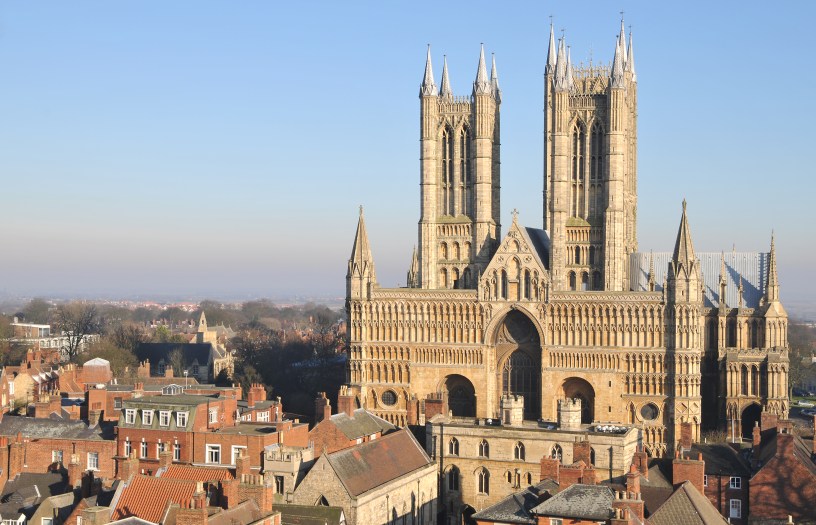
Church building over ten centuries consumed more labour, money and materials than any other form of building. Simon Jenkins, in his book, England’s Thousand Best Churches, is clear that they represent what is really one giant museum telling the story of this country. The village church paid for by the landowner was for the people of the village; it was their meeting place; a place of mystery but also of fun. It was the place that marked life and death. The cathedrals, the seat of bishops, were places of power. The church held perhaps a quarter of the country’s land, but this changed in the sixteenth century as the landholdings of the monasteries were freed up for secular occupation.
The Christian Church came to these islands first with the Romans and, when they left, a few communities and their building remained. It was the arrival of St Patrick from Ireland in the fifth century and Columba’s in Iona in 563 which marked a re-birth. Augustine’s arrival in Kent in 597 and his founding of a church in Canterbury further staked a claim for the Church. The 8th and 9th centuries witnesses Viking assaults which caused many missions to die out. It was the arrival in the tenth century of Benedictine monks from the Continent which led to the rebuilding in stone of previous wooden structures. These were minsters from which missions spread out across the land.
The building of churches in stone came in five main phases exemplified by styles of architecture.
Saxon from 7th to 10th century
A small number of fine church buildings which we refer to as Saxon remain from this time, one being St Lawrence, Bradford-upon-Avon and another, rather more restored in Brixworth near Northampton whose origin was as a missionary outpost looking to the main minster in Peterborough. Tell-tale signs of Saxon foundations are to be seen in some later buildings.
Norman
Norman architecture arrived with William the Conqueror. We can see traces in the west-front of Lincoln Cathedral where the characteristic rounded Norman arch is preserved in the otherwise gothic building. Only yards away from the cathedral is the Norman castle adding secular authority to that imposed by the Church. The Norman period saw the first large scale building of stone churches. The influence was French as were many of the master masons, but they gathered round them masons from the local areas. The number of people involved in building even a modest parish church was significant with masons, carpenters and labourers. For a cathedral the number was probably vast in relation to the size of the local community, and, of course the cost considerable.
Early Gothic
Gothic can be broken down further between Early Gothic (1175-1250), Decorated (1250-1350), Perpendicular (1350-1540). Early gothic was also strongly influenced by the French.
Decorated
Decorated gothic became distinctly English with masons carving intricate scenes often depicting the natural world with plants and small creatures. The Black Death put an end to the Decorative reflecting perhaps the decimation of the land. Beverley Minster offers all three gothic styles.
Perpendicular
Perpendicular was plainer, but often breathtaking. The mason’s skill had offered fine tracery windows in the Decorative period. In the Perpendicular, windows become large with stone kept to a minimum to allow for glass and the flooding of the building with light. My own local church of St Mary in Melton Mowbray is a fine example.
In the late fifteenth and early sixteenth centuries, church buildings attracted great expenditure from largely wealthy families and also from communities. This expenditure had an ‘other worldly; purpose of securing a passage after death into heaven. It is thought that around about half of all churches were restored or embellished in a fifty year period. Churches were places filled with colour and song.
I wrote an essay for my Humanities BA on the development of church architecture from the sixteenth to the nineteenth centuries. You can find it by following this link.
Reformation
Henry VIII’s Act of Supremacy of 1534 severed the links with Rome and began to embrace the Protestant notion of salvation which no longer could be secured by money. Between 1538 and 1547 shrines and chanties were suppressed. Over the next fifty years churches were stripped of their decoration. Depictions of saints were replaced by ever more elaborate family tombs and monuments.
The Dissolution of the Monasteries followed between 1536 and 1539. There had been some two hundred monasteries, all with land farmed by the monks and their lay brethren. One such, built by the Cistercians who did so much to advance British farming, was Buckland Abbey overlooking a tributary of the River Tamar on the Devon/Cornwall border. It was handed to the Grenville family who unusually converted the stone built church into a house. Elsewhere many monasteries were demolished and the building materials re-used. The house at Buckland was not particularly attractive and, after three generations of Grenvilles, it was owned by Sir Francis Drake. It decayed over the centuries only to be restored in the nineteenth century under architect, Samuel Cockerell. Other former monasteries, such as Newstead and Laycock Abbeys, fared better.
The seventeenth century saw churches filled with the sound of carpentry as pulpits and pews were installed. Churches became places where preachers would teach.
Classical
Classical church building typified the late seventeenth century in London where so much had been destroyed by fire in 1666. We can think of Sir Christopher Wren and the fine churches he built for the city, not least St Paul’s cathedral.
Eighteenth Century
In 1711 under Queen Anne an act was passed providing for a coal tax to finance the building of fifty new churches in London and its surrounding areas. We have the great architects of the time devoting their skills to church building:
- Thomas Archer design St John’s, Smith Square
- James Gibb designed St Mary le Strand
- Nicholas Hawksmoor, who worked with Vanburgh on Blenheim Palace, designed six principal parish churches in London, including St George;s Bloomsbury, as part of the Queen’s initiative.
Elsewhere, the eighteenth and early nineteenth century saw many church buildings neglected and falling into disrepair.
Gothic Revival
The Gothic revival in the reign of Queen Victoria put a stop to this decay and many fine churches were built particularly in the expanding urban areas. The master mason gave way for building contractors such as Dove Brothers. These churches include:
- Augustus Pugin designed St Giles Roman Catholic Church in Cheadle built by master builder George Myers (often referred to as pugin’s builder)
- St Chad’s Cathedral in Birmingham was also designed by Pugin and built by Myers.
- George Gilbert Scott designed the huge St George’s Doncaster.
- William Butterfield designed All Saints, Margaret Street, London W1 built between 1849 and 1859 by master builder John Kelk.
Dove Brothers of Islington built or restored 130 churches between 1858 and 1900. In 1867 they worked with Giles Gilbert Scott on the restoration of Croydon parish church (originally dating from the ninth century), now a Minster. In Islington six new churches were built, St Clements by Doves again with Gilbert Scott.
The Christian revival also embraced Low churches including St Marks Notting Hill and the Wesleyan Chapel in Dalston built by Doves working with Enoch Bassett Keeling. A number of Keeling’s designs included cast-iron columns instead of stone which would be painted in a number of colours; multicolour was also used in the brickwork raising many an eyebrow.
More recent churches
Five cathedrals were built in the late nineteenth and twentieth centuries.
- Liverpool has an Anglican Cathedral designed by Giles Gilbert Scott and built by Wm Morrison and a Roman Catholic Cathedral designed by Sir Frederick Gibberd and built by Taylor Woodrow
- Guildford has its Anglican Cathedral designed by Sir Edward Maule with substructure by Trollope and Colls with Dove Brothers as the main contractor.
- Truro Cathedral was designed by John and Frank Loughborough Pearson and built by John Thompson of Peterborough with Cornish granite and Bath stone.
- The new Coventry Cathedral was designed by Sir Basil Spence and built by John Laing.
- Westminster Roman Catholic Cathedral was built between 1895 and 1903, designed by John Francis Bentley and constructed by George Trollope and Sons.
A good number of Anglican, Roman Catholic and non-conformist churches were built in the twentieth century, including:
- St John Ermine in Lincoln designed by Sam Scorer and build by W and J Simons (Lincoln) Ltd
- St Jude in Hampstead Garden Suburb was designed by Sir Edwin Lutyens and built by J.W. Falkner and Sons
- St Paul’s Letchworth Garden City known as the Victory Church was built in 1923-24, designed by A.H. Ryan-Tennyson
- St Bonaventure’s Church in Welwyn Garden city was designed by T.H.B. Scott and built by contractors Ekins & Co of Hertford in 1926
- St Joseph’s RC church in Leicester built in the sixties by architect Tom Wilson.
Further reading:
Jenkins, Simon, England’s Thousand Best Churches (London: Penguin, 2000)

