
Spanning more than two centuries, the story of the Islington building contractors, Dove Brothers, tells much of the story of the British building industry from the time of the craftsman working alone to the limited liability builder carrying out multiple major contracts.
In writing this piece I am indebted to David Braithwaite for his wonderful book, Building in the Blood – The Story of Dove Brothers of Islington 1781-1981. As an introduction I can do no better than quote a little of the introduction to that book written by the then curator of the Sir John Soane’s Museum, Sir John Summerson:
Dove Brothers started as a modest family business, but, by perspicacity and jealously guarded standards of workmanship, they developed a reputation unique among builders. In a working life of 70 years, Frederick John Dove, one of the orginal partners, constructed, extended and restored hundreds of churches, as well as pioneering his firm’s diversification into school and hospital building, commercial and industrial developments, artisans’ dwelling and town and country mansions.
We need to go to Sunbury in Surrey to find the origins of the firm and John Dove, a carpenter, born in 1761. He was much involved in Sunbury Church life having worked on repairs to St Mary’s and held the office of churchwarden. He and his wife Sarah had two daughters and three sons. The first evidence of building contracting comes in 1781 when John engaged the services of a bricklayer. John’s son, William Spencer Dove, started working in Islington in the 1820s describing himself as a carpenter and builder. He and his wife Ann had many children including Frederick John (1830-1923), William Warren (1822-1880) and Henry Charles (1840-1895) who formed Dove Brothers. It was Frederick John who would be the leading light.
Eighteenth century London witnessed a great deal of building. John Nash cut the great curve of Regent Street from Carlton House to the landscaped parkland to the north. To the west were the Grosvenor and Portman estates and to the east the overcrowded district north of the strand. My great great great grandparents lived on the north side of the Strand and I described this in my blog on urban housing for the poor; one of their son was William Smith Williams who discovered the genius of Charlotte Bronte and became her mentor. He was the reader at her publishers Smith Elder.
Islington was slowly being built and the first project attributed to Doves were fifty dwellings on Milner Square in 1827. This was followed by the Islington Literary and Scientific Society building in Almeida Street in 1838 and then St Stephen’s Church Canonbury in 1839. St Stephen’s would be followed by many other churches, some 130 between 1858 and 1900. This reflected the Christian revival and architecturally the gothic revival. This work would demand highly skilled stone masons and carpenters. St Mary Abbott, Kensington designed by Gilbert Scott was a Dove project completed in 1870.
The latter part of the nineteenth century saw the provision of universal primary education and this demanded school buildings of which Dove built a number. They also built secondary schools including Archbishop Tenison’s on Leicester Square. There was more to come. The substructure work on the Law Courts in the Strand; buildings for commerce including 31 Poultry in the city and new Chambers at Clements Inn. Cold storage was provided for Smithfield Market in 1887. There were also contracts to build pubs and work carried out on country mansions. The mansions included Patteson Court, Reigate for Tom Nickolls, Lidhurst, Horsham for Ernest Noel, MP. Two refurbishment contracts were undertaken with church architect A.W. Bloomfield: Grogmagog, Cambridge for the Duke of Leeds and Palace House Beaulieu for Lord Henry Scott. Working people had suffered dreadful housing and Doves were commissioned by the 4 per cent Industrial Dwellings Company to erect block in High Street, Stoke Newington. The city livery companies were not forgotten with new panelling in the Merchant Taylors Hall and an oak staircase in the Tallow Chandlers Hall.
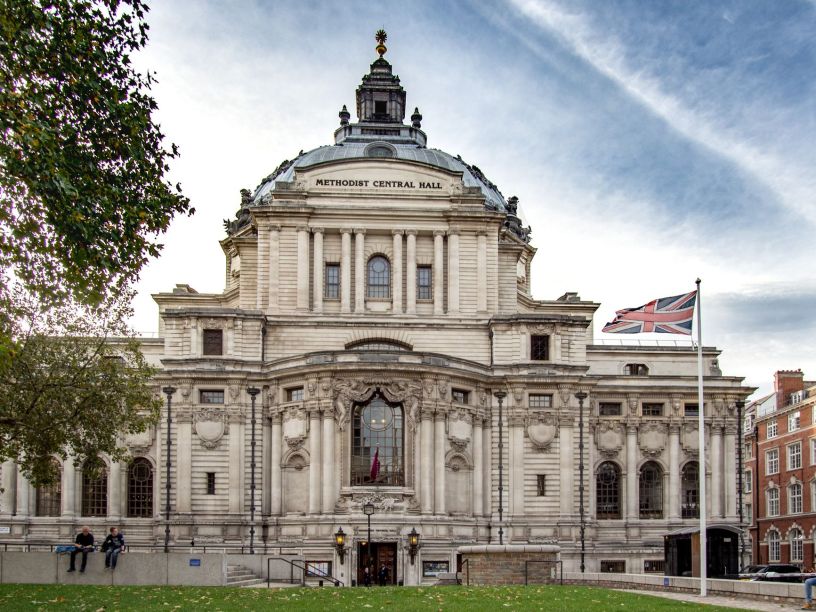
The transition from master craftsmen to building contractor took place in this period. In London, 57 contractors at the time of the Great Exhibition had grown to 250 twenty years later. The number of skilled men employed in England grew from 443,000 to 630,000. Iron and steel found their way onto building sites. The first iron framed flax mill was erected in Shrewsbury in around 1800. Brickyards appeared and Baltic timber was imported and transported around the country by canal. Reinforced concrete was explored on the continent, but banned in Britain until 1908. It was Mouchel in Victoria Street which introduced the technique invented by Hennebique in France. Doves embraced this on their groundbreaking project for the Wesleyan Methodist Central Hall Westminster (shown in the image). The Central Hall project included a number of modern features. The carpentry and stonework were prepared off-site at Dove’s yard. There was central heating and electric lighting. Passenger lifts were installed by William Wadsworth of Bolton.
Dove Brothers was incorporated in 1905. Site management, production of tenders and maintaining cash flow became increasingly important. Bills of quantities produced by professional Quantity Surveyors provided some protection for contractors, but competitive tendering proved a drain on resources with very low percentages won by even the best contractors. This competition also put pressure on wages.
Terra Cotta facings had become popular as a result of strikes by stone masons. In London they are shown well on the Prudential Building in Holborn and on the Natural History Museum in South Kensington. Walking around Leicester, I see many examples of excellent use.
Strikes were an issue. Much building work was low paid for long hours in sometimes dreadful conditions. The Operative Builders’ Union was formed in 1832 after the passing of the Reform Act. The employers came together in the Central Association of Master Builders of London in 1872 with members including Ashby and Horner, Colls and Sons, Holland and Hannen, John Mowlem and Company, Trollope and Sons and William Willetts. [Trollope and Colls merged in 1903; Holland and Hannen joined with Cubitt]
St Bartholomew’s Hospital was the oldest medical foundation in London, and Doves built the new outpatients department in 1907. Further work would follow after the war. Motor buses appeared on London streets and needed to be garaged. Doves built the London Motor Bus company garage in Hackney with a unique trussed girder system achieving a span of 35 metres with steelwork from Pierson and Company. Dove’s reputation was riding high and they were contracted to build Australia House on the Strand regarded as a significant architectural achievement.
In the First World War, the joiners shop produced mahogany propellers. The masons were occupied on urgent repairs to St Pauls. The stone pillars supporting the dome were showing alarming signs of crushing. It seems they had been filled with inferior stone. This had to be replaced by blocks of Aberdeen granite, a heavy but delicate operation.
In the aftermath of war, there were factories to be built. A big contract was for the reconstruction of the Odhams Building in Long Acre; the boom in newspaper sales had demanded more space. In the city, Dove’s built 52 Bishopsgate with an arch through to St Helens place where they installed a turntable for cars. (I remember this from my time as an articled clerk at 17 St Helens Place). On the Thames Embankment, Doves built Brettenham House which took its place alongside Trollope and Colls’ Shellmex House, Holland, Hannen and Cubitt’s Africa House and John Mowlem’s Thames House and Imperial Chemical House.
1929 offers a snap shot of Doves. Turnover was £500,000. There were 12 office staff excluding directors with five estimators and surveyors. The total workforce was 600 with 17 general foremen and 4 yard foremen. Contracts in hand totalled £750,000.
In the same year Dove took up shares in Scaffolding Great Britain which purchased a stock of tubes and fittings. Previously scaffolding had been made of wood. Large buildings were served by Spurgin endless chain lifts and steam crab engines. Diesel engines and electric motors followed and in time concrete mixers, mechanical excavators, dumper trucks and tower cranes. Horse drawn carts were used well into the twentieth century.
The construction of New Church House, Westminster had long been an ambition of Frederick Lionel Dove, but sadly he died in 1932 five years before the project started. It was ambitious, intended to house the General Synod, the Board of Education and the Central Board of Finance (of which I was a member for a number of years). It has four assembly halls, a chapel and administrative offices. The House of Commons and House of Lords used the buildings during the Second World War. The construction was of a steel frame clad in brick with multi-colour and stone facing, using much material from former buildings on the site next to Westminster Abbey.
Of much greater significance was the building of Guildford Cathedral. Trollope and Colls undertook the substructure contract in 1938 and Doves were appointed General Contractors and had built most of the choir using Sussex bricks before war was declared and the project put on hold. The work would be completed by Doves in the sixties.
The Second World War, and to a lesser extent the First, wreaked massive destruction on London which was left with a monumental task of rebuilding. Doves were on hand particularly for the more ancient buildings of which I mention just a few. The first and oldest church in London was All Hallows-by-the-Tower (of London) ; bombing had revealed Saxon arches and Roman bricks. The reconstruction was supported by donations from throughout the Commonwealth including four 21 metre lengths of British Columbian pine covered in Rhodesian copper to create the spire. This was followed by the Temple church which Doves had already worked on before the war. The destruction was terrible. Pillars had to be replaced with new Purbeck marble which necessitated the re-opening of a quarry. The church of St Clement Dane in the Strand had its reconstruction initiated by the RAF. Of huge importance to Londoners was St Mary le Bow whose bells bring to an end the nursery rhyme. The bells were re-cast by the Whitechapel Bell Foundry using the original metal. Restoration work on St Pauls carried out by Dove required fifty miles of scaffolding designed by bridge builders, Freeman Fox and Partners.
University College London had more undergraduates than any other British university and had suffered significant war damage. Doves started work on the Central Building and Donaldson Library in 1947. Waterhouse and Ripley’s Medical School, was begun in 1951 and was of steel frame construction with reinforced concrete floors. The roof was of concrete insulated with cork and covered with copper. I write of building with steel and in concrete in the links.
New building was beginning to be undertaken and in 1950, Doves used pre-stressed concrete for the first time on Queen Mary College in the East End. The cross block had beams of ten metres, each with a Magnel-Blaton cable of 48 strands of high tensile cold drawn steel wires. The use of these resulted in a 75% saving in steel. Elsewhere, Doves built the Royal Military Chapel at Wellington Barracks which received a Civic Trust award in 1964. The Sir John Cass and Red Coat School followed.
The sixties saw Dove craftsmen in Oxford on a major restoration of Christ Church and a new hall of residence at Worcester College.
Doves had worked at Woburn Abbey in 1898 and in the sixties carried out extensive restoration.
Lt Colonel William Watkins Dove had become a director in 1925 and succeeded his father, Frederick Lionel, as Governing Director. He guided the company through the interwar and postwar years; he died in 1967. The family succession ceased shortly after. The non family directors executed one of the first management buyouts in 1970. The company ceased to trade in 1993.
Further reading:
David Braithwaite, Building in the Blood – Thje Story of Dove Brothers of Islington 1781-1981 (London: Godfrey Cave, 1981)

