
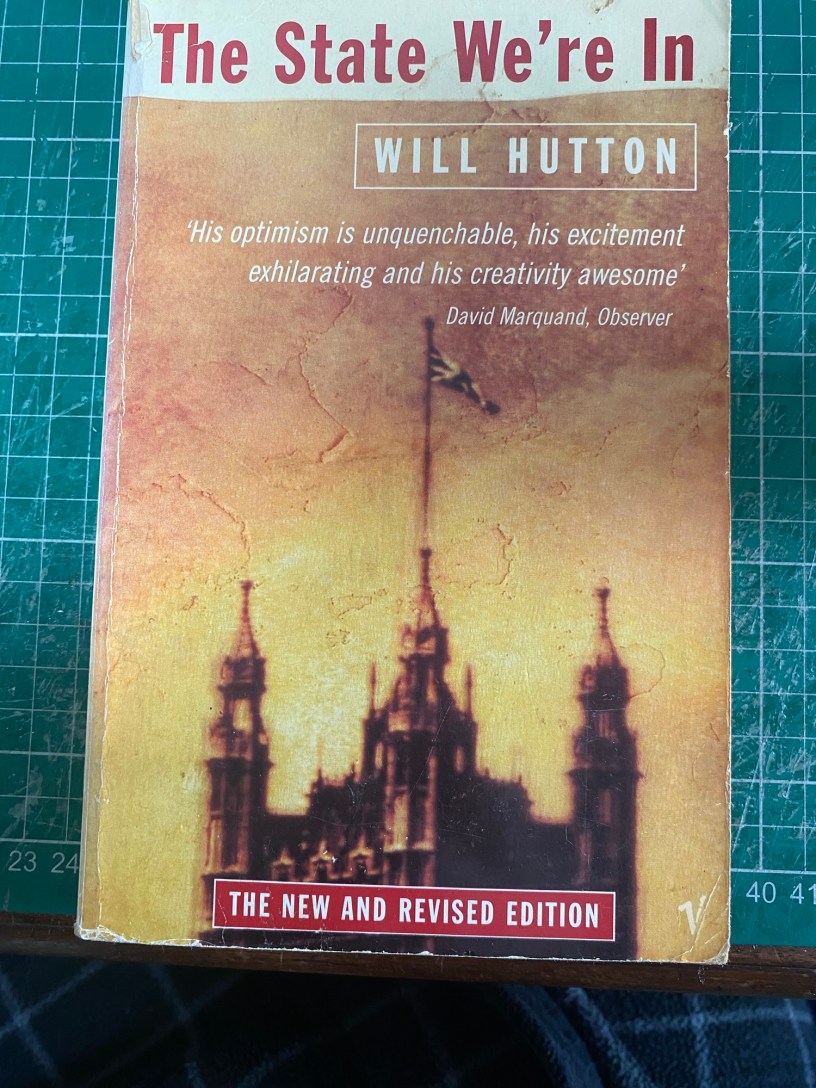
I read Will Hutton’s The State We’re In when it was first published thirty years ago. I had left my job in the accounting profession for a new career in the not for profit sector. In many ways I was filled with hope.
In his Observer piece this Sunday Hutton writes:
‘Yet in 2026 we are where I feared in 1996 that we would be. Continued inattention to fixing the financial architecture in which our companies can grow and flourish has meant that many of our great businesses have been dismembered while others decay and stagnate. Too many young companies that might replace them are acquired or sold abroad. Societally, living standards are barely increasing while a century of improving public health and lengthened life expectancy is being reversed, especially in our former industrial heartlands. A great economy cannot be built upon a weak society. The nascent anti-Europeanism of the mid-1990s has morphed into Brexit. Internationally, the liberal order that underpinned growing postwar prosperity is being shredded.’ Hutton’s update, Escaping the State We’re In is published by the Fairness Foundation.
A grim list indeed.
My researches into the history of manufacturing post WW2 can shed some light. Early on the Macmillan gap in finance for SMEs had been recognised and what would become ICFC formed. In my early years in accounting I worked with them and saw the positive benefit. Yet it wasn’t long before exit returns began to loom large; investors could achieve higher returns by selling than by staying invested.
The past thirty years have seen this writ large with chairmen of once great public companies appointed to achieve shareholder value by selling to foreign purchasers.
Why is this the case?
British capital has never been keen on manufacturing. There was a clear preference for overseas trade. Minerals have long been popular since the land gentry discovered they were sitting on coal mines, before that tin and copper and after that iron ore. Marry the two and you have South African gold and Zambian copper. We can think of RTZ and Lonrho. I explore the history of finance for manufacturing in this link.
We now have some of the best brains betting on Bitcoin and piling into Hedge Funds.
Call me old fashioned.
Whitworth, Wellcome, Weston and Morris created brilliant companies and gave away to good causes the wealth they made.
Ferranti was a brilliantly inventive company that steer away from third party finance until it was too late and then they chose badly American money.
Marconi was equally brilliant and George Nelson of English Electric was equally wide when he bought them after the war. They pumped cash into Arnold Weinstock’s war chest at GEC which George Simpson proceeded to squander on over prices dot coms. Mercifully Marconi continues to thrive as part of BAE Systems. Simpson had already sold out the brilliant Lucas to the Americans.
Rant over – for now.
 Philip Hamlyn Williams